

Intellectuality
-
The human nature created by Allah Almighty requires the union of men and women. In this way, the human race will continue and life on earth will continue. Allah Almighty wanted in this way to preserve the blessings of the world and to subjugate the natural forces of nature to humanity for as long as He wills. If Allah Almighty had not created humanity with such a nature, the earth would have perished in a short time.
-
In Islam, the attention paid to the spiritual and psychological aspects is no less than the attention paid to the material aspects. Similarly, the community is expected to adhere to the same moral standards required of an individual.
-
The Messenger of Allah (peace and blessings of Allah be upon him) said: “Search for the Night of Power in the odd nights of the last ten days of Ramadan.” (Narrated by Imam Bukhari and Imam Muslim). Our scholars, who have studied the evidence about the Night of Power, have stated that there are some indications that the twenty-seventh night of Ramadan (the night between the twenty-sixth and twenty-seventh) is the Night of Power. It is also stated in the interpretation of Surah Al-Qadr that there are slight indications that the Night of Power is on the twenty-seventh night.
-
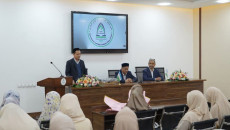
Student Robiyakhon Muzaffarkhanova managed to memorize and complete 30 chapters of the Holy Quran in 12 hours. The tradition of memorizing the Quran in one day, which has been ongoing at the institution since 2014, is showing good results this year as well.



-
If it were not for Pharaoh and those like him, we would never have understood the law of testing! This law is the law of testing the strong with power, fame, and kingdom. And the weak are tested through patience and struggle! If it were not for Pharaoh, we would never have understood that Allah gave His servants the choice to worship Him or not to obey Him!
-
Five hundred years ago, the English writer and philosopher Thomas More wrote "Utopia" about the most just and ideal society in the future. However, among similar works, Abu Nasr Farabi's book "The City of Virtuous People" stands out for its richness of meanings.
-
Our tenth lesson on Deism. We turn to our deist interlocutor, as usual, with a question:
-
We talk a lot about "nation", "nationality", "national values", "national customs", but do we use these concepts correctly? What should we really understand by "nationality"? What are the characteristics of our nation? Today we are looking for answers to these questions.



-
We turn to the ninth lesson and another deist: - Is the God in whom you believed just or unjust (zinhor-bazinhor!)? I think you don't believe in a cruel god and accept that the creator is just.
-
Our eighth lesson will also take the form of a conversation with another deist. We have questions for him: - Who is a person, where did he come from, where is he going? - Why was this world created? - What does the owner of this world want from us?